— Руководство администратора FreePBX на русском языке
— Руководство администратора Cisco UCM/CME на русском языке
— Руководство администратора по Linux/Unix
Навигация
Серверные решения
Телефония
FreePBX и Asterisk
Настройка программных телефонов
Корпоративные сети
Протоколы и стандарты
Обзор Cisco UCCX
Решение Cisco для контактных центров UCCX является решением для взаимодействия с клиентом. Основными функциями CCX является обеспечение функционала голосового меню Interactive Voice Response (IVR) и распределение вызова Automatic Call Distribution (ACD).
Продвинутый курс по Asterisk
Концентрат редких знаний, для внедрения Asterisk в крупных предприятиях. Все это мы собрали в одном курсе для тебя.
Голосовое меню (IVR) это программный продукт, обеспечивающий клиента возможностью самообслуживания. Обычно, IVR используется для входящих вызовов. При звонке клиенту предлагается нажать одну или несколько кнопок для связи с тем, или иным отделом, предоставляется возможность распознавания речи Automatic Speech Recognition (ASR), автоматически произносится запрашиваемая информация по технологии Text to Speech (TTS). Данное взаимодействие осуществляется по протоколу Media Resource Control Protocol (MRCP), который описан в RFC 4463.
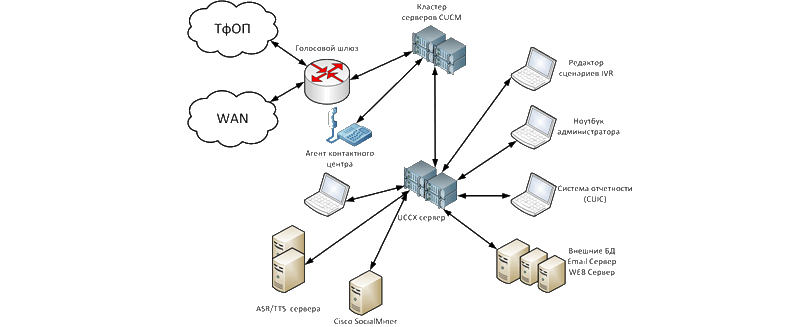
Посмотрите структуру взаимодействия UCCX в корпоративном сегменте:
Корпоративная сеть с элементом контактного центра на базе решение Cisco Unified Contact Center Express весьма обширна, поэтому, давайте разбираться:
Сервер Cisco UCCX, как и любой другой продукт, создан для получения прибыли и, соответственно, имеет лицензионные и пакетные ограничения. В данном описании собраны опции, которые ограничиваются лицензией:
Распределение опций по пакетам и соответствующее лицензирование:
Опция
Cisco Unified CCX Standard
Cisco Unified CCX Enhanced
Cisco Unified CCX Premium
Порты IVR
Не ограничено. Определяется производительностью сервера
Есть
Два IVR порта на одного агента, интеграция по интерфейсу JDBC, исходящие e-mail, VXML для голосовых приложений.
Аудио файлы и обработка DTMF
Есть
Есть
Есть
Контроль вызова
Есть
Есть
Есть
Маршрутизация вызовов, ACD алгоритм и очереди.
Есть
Есть
Есть
Контроль агента
Контроль вызова, коды отбоя, контроль очереди в реальном времени
Автоматические задачи, CTI процессы, запись вызовов по требованию, интегрированный чат
Интегрированное место, работа с e-mail и чатами, исходящий обзвон, возможности WFO.
Отчетность
Есть
Дополнительная историческая отчетность реального времени
Есть
Место «супервизора»
Контроль агентов, метрики реального времени для распределения вызовов.
Командный чат, мониторинг без ведома агента, запись разговора агента по требованию
Есть
Функции автосекретаря
Есть
Есть
Есть
Интеграция с Cisco IM&P
Есть
Есть
Есть
SNMP индикаторы
Есть
Есть
Есть
Отказоустойчивость
Нет
Есть
Есть
Приоритет в очереди
Нет
Есть
Есть
MRCP для TTS/ASR
Нет
Нет
Есть
Сервер Cisco UCCX может быть установлен в виртуальной среде VMware, а так же, на следующих аппаратных платформах:
Продвинутый курс по Asterisk
Концентрат редких знаний, для внедрения Asterisk в крупных предприятиях. Все это мы собрали в одном курсе для тебя.
Реализация автосекретаря на базе решений компании Cisco
При звонке практически в любую компанию мы обычно слышим приятный или не очень голос, напоминающий нам, куда мы дозвонились и предлагающий выполнить какие-то действия. Мы попали… попали на автосекретаря. Автосекретарь (англ. Auto Attendant/AA) — это, как правило, простейший случай Интерактивного Голосового Меню (англ. Interactive Voice Response/IVR), позволяющий при звонке в компанию донабрать номер внутреннего абонента, отправить голосовое сообщение или факс, связаться с секретарем.
В этой статье я предлагаю ознакомиться с вариантами реализации автосекретаря на базе решений компании Cisco. Их как минимум четыре и при внедрении решений унифицированных коммуникаций Cisco, нам нередко задают вопрос, на чём именно реализовать данный функционал. Давайте рассмотрим плюсы и минусы каждого из них.
1. Разработка или использование готовых скриптов на TCL и VXML
Данное решение полностью программное, функциональность встроена в операционную систему Cisco IOS, поддерживается на маршрутизаторах c активированным набором функций Unified Communications (UC). Примеров IVR скриптов для оборудования Cisco достаточно много. Например, на хабре можно найти варианты для TCL и VXML.
Если вам подходит алгоритм его работы — берем, настраиваем и пользуемся.
Данный вариант подойдет при небольшой нагрузке по количеству одновременных вызовов и может быть интегрирован с любой АТС (не только Cisco).
2. Использование Cisco Unity Express (CUE)
Данное решение представлено в виде модуля (например, SM-SRE-700-K9) в маршрутизаторы Cisco 1861, 2800, 2900, 3800, 3900 серий. Скрипт IVR создаётся с помощью Cisco Unified Communications Express Editor. Решение достаточно функционально, а процесс создания скрипта и логика работы сильно пересекается со старшим решением на базе UCCX, которое разберем ниже. Cisco Unity Express интегрируется с Cisco Unified Communications Manager и Cisco Unified Communications Manager Express, как автосекретарь может работать и в standalone режиме.
3. Использование Cisco Unity Connection (CUC)
Данное решение является сервером голосовой почты и устанавливается на отдельную виртуальную машину. Две виртуальные машины c CUC объединяются в отказоустойчивый кластер. Встроенные средства CUC позволяют создать логику работы автосекретаря. Используются встроенные обработчики вызовов — handlers.
4. На базе контакт-центра (Cisco Unified Contact Center Express или Cisco Unified Contact Center Enterprise)
Максимально функциональное и гибкое решение. UCCX, также как и CUC, устанавливается на отдельную виртуальную машину. Две виртуальные машины можно объединить в отказоустойчивый кластер. Для автосекретаря достаточно настройки функционала IP IVR. Скрипт IVR создаём с помощью Cisco Unified CCX Editor. UCCX интегрируется с Cisco Unified Communications Manager. Максимальное количество сессий ограничивается мощностью виртуального сервера (шаблона виртуальной машины) и количеством приобретенных лицензий.
Мы рассмотрели различные варианты организации автосекретаря. Выбор во многом зависит от того, какое решение имеется или внедряется (CUCMe, CUCM, BE6K или сторонняя АТС), а также какие требования по функциональности, производительности и надёжности предъявляются.
Самым простым вариантом будет IVR на базе TCL/VXML, а самым функциональным и производительным — на базе Cisco Unified Contact Center Express/Enterprise.
Решение Cisco Unity Connection не всегда заслужено часто обходят вниманием. Обычно, при приобретении продуктов унифицированных коммуникаций Cisco, Cisco Unity Connection идет в комплекте с приобретаемыми лицензиями (например, при приобретении UWL лицензий, а также в комплекте Business Edition). В этом случае для реализации автосекретаря ничего дополнительно приобретать не требуется.
Решение Cisco Unity Express позволяет снять нагрузку (по сравнению с вариантом использования TCL/VXML) по обработке вызовов с маршрутизатора, занимает промежуточное положение между скриптовыми решениями на IOS и решениями на выделенных серверах. Оно довольно простое и удобное, поэтому подойдет для решения задачи организации автосекретаря собственными силами ИТ подразделения компании, т.к. имеет простой встроенный web-редактор для скриптов с поддержкой основных действий.
Есть варианты интеграции систем IP телефонии Cisco и со сторонними решениями для реализации функции автосекретаря, но это уже совсем другая история…
База знаний
ОБЗОР CISCO UCCX
Решение Cisco для контактных центров UCCX является решением для взаимодействия с клиентом. Основными функциями CCX является обеспечение функционала голосового меню Interactive Voice Response (IVR) и распределение вызова Automatic Call Distribution (ACD).
Голосовое меню (IVR) это программный продукт, обеспечивающий клиента возможностью самообслуживания. Обычно, IVR используется для входящих вызовов. При звонке клиенту предлагается нажать одну или несколько кнопок для связи с тем, или иным отделом, предоставляется возможность распознавания речи Automatic Speech Recognition (ASR), автоматически произносится запрашиваемая информация по технологии Text to Speech (TTS). Данное взаимодействие осуществляется по протоколу Media Resource Control Protocol (MRCP), который описан в RFC 4463.
Посмотрите структуру взаимодействия UCCX в корпоративном сегменте:
Корпоративная сеть с элементом контактного центра на базе решение Cisco Unified Contact Center Express весьма обширна, поэтому, давайте разбираться:
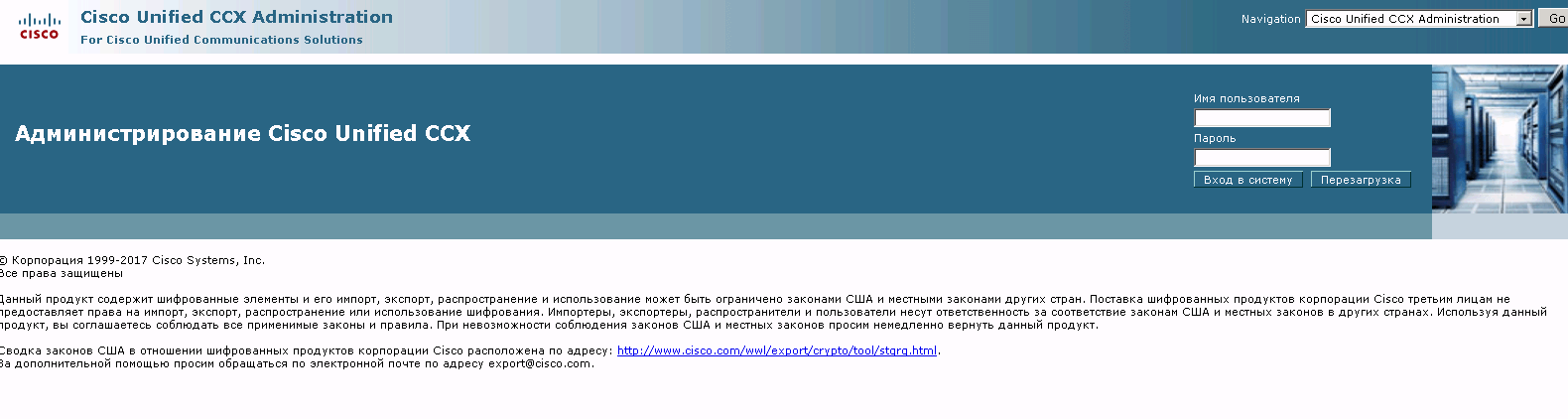
Веб – интерфейс продукта сделан в привычном для Cisco дизайне:
Сервер Cisco UCCX, как и любой другой продукт, создан для получения прибыли и, соответственно, имеет лицензионные и пакетные ограничения. В данном описании собраны опции, которые ограничиваются лицензией:
Распределение опций по пакетам и соответствующее лицензирование:
Опция
Cisco Unified CCX Standard
Cisco Unified CCX Enhanced
Cisco Unified CCX Premium
Порты IVR
Не ограничено. Определяется производительностью сервера
Есть
Два IVR порта на одного агента, интеграция по интерфейсу JDBC, исходящие e-mail, VXML для голосовых приложений.
Аудио файлы и обработка DTMF
Есть
Есть
Есть
Контроль вызова
Есть
Есть
Есть
Маршрутизация вызовов, ACD алгоритм и очереди.
Есть
Есть
Есть
Контроль агента
Контроль вызова, коды отбоя, контроль очереди в реальном времени
Автоматические задачи, CTI процессы, запись вызовов по требованию, интегрированный чат
Интегрированное место, работа с e-mail и чатами, исходящий обзвон, возможности WFO.
Отчетность
Есть
Дополнительная историческая отчетность реального времени
Есть
Место «супервизора»
Контроль агентов, метрики реального времени для распределения вызовов.
Командный чат, мониторинг без ведома агента, запись разговора агента по требованию
Есть
Функции автосекретаря
Есть
Есть
Есть
Интеграция с Cisco IM&P
Есть
Есть
Есть
SNMP индикаторы
Есть
Есть
Есть
Отказоустойчивость
Нет
Есть
Есть
Приоритет в очереди
Нет
Есть
Есть
MRCP для TTS/ASR
Нет
Нет
Есть
Сервер Cisco UCCX может быть установлен в виртуальной среде VMware, а так же, на следующих аппаратных платформах:
Cisco Unified Contact Center Express Administration Guide, Release 10.0(1)
Book Title
Cisco Unified Contact Center Express Administration Guide, Release 10.0(1)
Chapter Title
Unified CCX Introduction
View with Adobe Reader on a variety of devices
View in various apps on iPhone, iPad, Android, Sony Reader, or Windows Phone
Results
Chapter: Unified CCX Introduction
Unified CCX Introduction
Unified CCX provides a multimedia (voice, data, and web) IP-enabled customer-care application environment that enhances the efficiency of contact centers by simplifying business integration, easing agent administration, increasing agent flexibility, and enhancing network hosting.
The following sections provide an overview of the configuration and management components of the Unified CCX product family:
Unified CCX Components
This section describes the following components of the Unified CCX system:
Unified Gateway—Connects the Cisco Unified Communications family of products to the Public Switched Telephone Network (PSTN) and to other private telephone systems such as PBX.
Unified CM Server—The Cisco Unified Communications Manager ( Unified CM ) provides the features required to implement IP phones, manage gateways, provide failover and redundancy service for the telephony system, and direct Voice over IP (VoIP) traffic to the Unified CCX system.
Note
Cisco Unified Communications Manager was previously known as Unified Call Manager. This guide uses Cisco Unified Communications Manager at the first occurrence and Unified CM for later occurrences.
Unified CCX Server—Contains the Unified CCX Engine that runs applications, including Cisco script applications, Unified CM user integration, Cisco Unified Intelligent Contact Management Enterprise (Unified ICME) translation-routing and post-routing applications, Busy applications, Ring No Answer applications, and Voice Extensible Markup Language (VXML) 2.0 applications.
You can position your Unified CCX application server anywhere on the IP network and administer your applications from a web browser on any computer on the IP network. Because Unified CCX uses an open architecture that supports industry standards, you can integrate your applications with a wide variety of technologies and products such as Enterprise databases and Unified CCX Agent Desktop. The Unified CCX Server has the following components:
Historical Reports Database Server—Dedicated server that stores Unified CCX database for the following datastores: Configuration Datastore (CDS), Historical Datastore (HDS), Repository Datastore (RDS), and Agent Datastore (ADS).
Note
If you are using Microsoft Internet Explorer Version 6.0 or later or Mozilla Firefox Version 2.0 or 3.0 browser, verify that the popup blocker is disabled.
Cisco SocialMiner—Acts as the endpoint that hosts the widgets that end users and agents use during the chat session. SocialMiner accepts the chat request, communicates with Unified CCX to allocate an agent for the chat and then establishes the chat session between agent and end user.
Unified CCX Editor—Allows application developers to use a simple Graphical User Interface (GUI) to create, modify, and debug Unified CCX scripts for automating customer interactions. Each script consists of a series of steps, implemented as Java Beans.
Unified CCX Administration and Unified CCX Serviceability web interfaces—Provides access through a web browser for administrators to configure and manage Unified CCX datastores, servers, and applications.
Cisco IP Agent and Supervisor Desktops—Desktop programs that allow Unified CCX agents and supervisors to log in to the system, change agent states, and monitor status.
Media Resource Control Protocol (MRCP) Automatic Speech Recognition (ASR) server—(optional) Dedicated server that performs real-time speech recognition.
MRCP Text-to-Speech (TTS) server—(optional) Dedicated server that converts text into speech and plays it back to the caller.
Note
Support for high availability and remote servers is available only in multiple-server deployments.
Cisco Unified Intelligence Center—A web-based reporting solution for historical reports that provides detailed Call Contact Call Detail Records (CCDRs), application performance, and traffic analysis information.
Unified CCX Product Family
The Unified CCX product family provides contact-processing functions for your Cisco Unified Communications solution.
The software package that you choose determines which steps, components, and subsystems you receive. Each Unified CCX product includes Unified CCX Engine and Unified CCX Editor.
Unified IP IVR
The Unified IP IVR is a multimedia (voice, data, web) IP-enabled interactive voice response solution that offers an open and feature-rich foundation for the creation and delivery of Unified IP IVR applications through Internet technology.
Unified IP IVR automates call handling by autonomously interacting with contacts. Using Unified IP IVR, you can create applications that answer calls, provide menu choices for callers, obtain caller data such as passwords or account identification, and transfer calls to caller-selected extensions. You can also create Unified IP IVR applications that respond to HTTP requests, perform outbound calling, send e-mail, and process VXML 2.0 commands.
The Unified IP IVR package provides the following features:
Java Database Connectivity (JDBC) support—Unified IP IVR applications can access Oracle, Sybase, and IBM DB2 databases.
Real-time reporting client—Unified IP IVR applications can generate a variety of reports that provide detailed information about the real-time status of your system.
Cisco Unified Intelligence Center—A web-based reporting solution for historical reports that provides detailed Call Contact Call Detail Records (CCDRs), application performance, and traffic analysis information.
Automatic Speech Recognition (ASR)—Unified IP IVR applications can take advantage of ASR to provide callers with the option to use speech to navigate through menu options.
Text-to-Speech (TTS)—Unified IP IVR applications can use TTS to read back documents and prescripted prompts to callers.
Unified Contact Center Express
Cisco Unified Contact Center Express (Unified CCX) is an IP-based Automated Call Distribution (ACD) system that queues and distributes incoming calls to Unified CCX agents, who can be groups of Unified CM users for Unified CM integration.
You can use Unified CCX applications to route calls to specific agents. You can also integrate Unified CCX with Unified IP IVR to gather caller data and classify incoming calls.
Unified CCX includes a web-based real-time and historical reporting system that you can use to monitor system, Contact Service Queue (CSQ), and resource performance.
The Unified CCX system consists of the following major components:
Resource Manager—Application program that monitors Unified CCX agent phones and allows you to organize agents into resource groups or skills-based partitions according to the types of calls each group can handle.
CSQ—Application program that places incoming calls in a queue and distributes them to the appropriate set of agents as the agents become available.
Unified CCX Agent Desktop—Application program that Unified CCX agents run on their desktop computers to log in to the system, change Unified CCX state, and monitor status.
The following licensing options are available for the Unified CCX system:
Unified CCX Standard (designed for entry-level users)—Includes the steps necessary for creating basic Unified CCX applications, including IP Phone Agent (IPPA) and skills-based routing, and does not include Cisco Agent Desktop (CAD).
Unified CCX Enhanced (designed for enterprise-level users)—Includes all functions of Unified CCX Standard, plus support for priority queuing. Includes a license to enable custom Java extensions.
Unified CCX Premium—Adds full Unified IP IVR support (except for Unified ICM integration) including database integration, Voice eXtensible Markup Language (VoiceXML), HTML web integration, custom Java extensions, and e-Notification services. The outbound feature is now bundled with the Premium package. You will receive one outbound seat free with each premium seat. The maximum number of outbound seats supported will be based on the hardware type.
Unified CCX Outbound IVR—You need to have a Unified CCX Outbound IVR license in addition to a Unified CCX Premium license to enable this feature. You can increase the number of ports for an existing Outbound IVR license. The Display License submenu option displays the licensed Outbound IVR ports and the sum of the dedicated Outbound IVR ports for all IVR campaigns that are running currently in your Unified CCX. The dedicated Outbound IVR port for a campaign is the number of IVR ports that you want to reserve for a campaign based on the number of CTI ports available in the outbound call control group.
Note
The Unified CCX Enhanced package and the Unified CCX Premium package are provisioned in the same way.
Unified CCX Cluster Architecture
Support for high availability and remote servers is available only in multiple-server deployments.
The Unified CCX cluster consists of one or more servers (nodes) that are running Unified CCX components in your Unified CCX deployment.
If you deploy Unified CCX components on a single server, the Unified CCX cluster (often referred to as cluster in this manual) consists of that server. If you deploy Unified CCX on multiple servers, the cluster includes the Unified CCX server and standby server on which you installed Unified CCX. The Unified CCX cluster can support up to two Unified CCX Servers, one designated as the active Unified CCX Server and the other designated as the standby Unified CCX Server for high availability purposes.
When you install or upgrade Unified CCX on a server, you designate the cluster to which the server will belong by designating the cluster profile for that cluster.
Cluster architecture accommodates high availability and failover because if a component fails, a secondary server will take over the functionality lost by that failed component.
All Unified CCX servers within the cluster are configured identically and installed with the same features. One server is designated the active server.
Unified CCX Active Server
Support for high availability and remote servers is available only in multiple-server deployments.
The Unified CCX active server makes global decisions for the cluster and keeps track of calls in the CSQs, agent states (if Unified CCX is installed) and generating historical detail records.
Note
Only one server in the cluster can be the active server at any given time.
If the active server fails, the Unified CCX provides automatic failover to the standby server. If the active server fails (for example, in the event a hardware failure occurs or the Unified CCX Engine process terminates), some calls being handled by the server are lost. The lost calls are restricted to those being handled by the system (those in the IVR stage or in queue). Calls answered by agents continue to remain live even though related data on the agent desktop is lost. When the standby server takes over as the new active server, call processing continues.
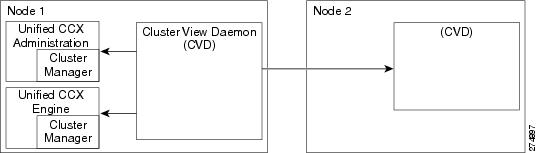
A Unified CCX cluster consists of the one or more servers (nodes) that run Unified CCX components in your Unified CCX deployment.
Cluster management consists of two main elements: Cluster Manager
Receives updates about cluster status and subsystem states.
Cluster View Daemon (CVD)
Java code that interacts with Platform Service Manager and implements internode communication on behalf of the cluster. It detects availability of the other nodes, components and services, provides consistent cluster view, and dynamically elects a master service.
The CVD has two interfaces:
Node Manager to monitor and control local processes
Cluster Manager publisher or subscriber to communicate with local applications, such as Engine and Application Administration
One that monitors outside the node and communicates with other nodes in the cluster
Unified CCX Engine
The Unified CCX Engine enables you to run multiple applications to handle Unified CM Telephony calls or HTTP requests.
The Unified CCX Engine uses the Unified CM Telephony subsystem to request and receive services from the Computer Telephony Interface (CTI) manager that controls Unified CM clusters. The Unified CCX Engine is implemented as a service that supports multiple applications.
You can use a web browser to administer the Unified CCX Engine and your Unified CCX applications from any computer on the network. Unified CCX provides you the following two web interfaces:
Unified CCX Administration web interface— Used to configure system parameters, subsystems, view real-time reports that include total system activity and application statistics, and so on
Unified CCX Serviceability web interface— Used to view alarm and trace definitions for Unified CCX services, start and stop the Unified CCX Engine, monitor Unified CCX Engine activity, and so on
Note
If you are using Microsoft Internet Explorer Version 6.0 or later or Mozilla Firefox Version 2.0 or 3.0 browser, verify that the popup blocker is disabled.
Depending on the Unified CCX products that you are using, the Unified CCX server may employ as many as 14 subsystems for communicating with other services: Applications Manages the applications in the Unified CCX Engine and other features such as session management. Cisco Media Configures Cisco Media Termination (CMT) dialog control groups, which can be used to handle simple Dual Tone Multifrequency (DTMF)-based dialog interactions with customers. Core Reporting Provides information for Unified IP IVR real-time reports. Database Handles the connections between the Unified CCX server and the enterprise database. eMail Adds components to the Unified CCX Engine that allows the engine to send email messages. Enterprise Server Communicates data for screen pops to the Unified CCX Agent Desktop. HTTP Adds components to the Unified CCX Engine that allow the engine to respond to HTTP requests. ICM Subsystem Manages the connection between the Unified CCX server and ICM. Unified CM Telephony Manages the connection between Unified CM CTI Manager and the Unified CCX Engine. MRCP ASR Allows a script to respond to voice input in addition to DTMF using the MRCP protocol. MRCP TTS Composes voice prompts that are generated real-time from text, such as speaking the words in the text of an email message using the MRCP protocol. Resource Manager-Contact Manager (RmCm) Allows Unified CCX to monitor agent phones, control agent states, route and queue calls, and manage the historical reporting feature. Chat Allows Unified CCX to configure and manage Web Chat. Voice Browser Manages Voice Browser functionality. Unified CCX Voice over Internet Protocol (VoIP) Enables remote recording and monitoring.
Note
Recording and monitoring over preconfigured SPAN port is not supported in high availability over WAN deployment of Unified CCX.
Set Up Unified CCX
Provisioning is the process of allocating resources and devising strategies for using the resources to support the needs of your business.
Configuring is the process of making applications available to the Unified CCX system.
Provision Telephony and Media Subsystems
The Unified CCX telephony and media subsystems manage telephony and media resources and communicate with supporting telephony and media systems.
Depending on the Unified CCX applications you plan to use, you need to provision some or all of the following subsystems:
Configure Unified CCX Subsystems
You need to provision your Unified CCX subsystems to enable the Unified CCX Engine to run multiple applications to handle Unified Communications calls or HTTP requests.
Note
You need to configure a particular subsystem only if you are using Unified CCX applications that require it and which are installed and activated using the appropriate license.
To continue the Unified CCX system configuration process, connect to the Unified CCX Administration web interface and perform the task in the links listed in the Related Topics section.
Provision Unified CCX Subsystem
If you have purchased any of the three versions of Unified CCX, you must provision the Unified CCX subsystem.
Provision the following settings on the Unified CCX subsystem:
RmCm Provider
The Resource Manager (RM) of the Unified CCX system uses a Unified CM user (called a Unified CM Telephony provider) for monitoring agent phones, controlling agent states, and routing and queueing calls.
Resources
Agents that answer calls are also called resources. After you create a resource group, you must assign agents (resources) to that group. You can assign skills to agents if you have a Unified CCX Standard license.
Resource Groups
Collections of agents that your CSQ uses to handle incoming calls. To use resource group-based CSQs, you must specify a resource group.
Skills
(Unified CCX Standard license) Customer-definable labels that are assigned to agents. You can route incoming calls to agents who have the necessary skills or set of skills to handle the call.
CSQs
After you assign an agent to a resource group or assign skills to an agent, you need to configure the agent for the CSQ to which the agent will be assigned.
Agent-Based Routing Settings
You can configure Automatic Work and Wrapup Time settings for the agent-based routing feature from the Agent-Based Routing Settings page.
Remote Monitoring
If you want to associate agents and CSQs that will be monitored by remote supervisors, you need to configure remote monitoring settings.
Teams
If you want to create or associate teams with various agents, CSQs, and supervisors, you need to configure team settings.
Provision Additional Unified CCX Subsystems
The additional Unified CCX subsystems provide Unified ICME, HTTP, Database, and email features.
Provision the following subsystems:
Unified ICME—The ICM subsystem communicates with Unified ICME software.
HTTP—The HTTP subsystem enables Unified CCX applications to respond to requests from a variety of web clients.
Database—The Database subsystem enables Unified CCX applications to communicate with enterprise database servers.
eMail—The eMail subsystem enables Unified CCX applications to create and send email.
View License Information
The initial license configuration is part of the Setup Wizard procedure (during installation). The uploaded licenses define the feature set for a Unified CCX system. See Cisco Unified Contact Center Express Install and Upgrade Guide for more information on obtaining and installing licenses for Cisco Unified CCX.
You can add additional licenses using the Add Licenses submenu option.
Note
If two licenses with the same feature name are uploaded, the Unified CCX Administration Display Licenses web page will display the earlier date as the expiry date. Although the expiry date refers to the earlier date, it does not mean that the license expires on the date displayed in the «Display Licenses» page if you upload a permanent license.
If a permanent license is uploaded over an already existing temporary license, a license expiry message is displayed for the temporary license for the feature. This license expiry message is displayed both in License Information and Appadmin home page. The Appadmin home page displays a popup message.
For Unified CCX, if you have a premium license with an Outbound IVR license, this web page will display the number of licensed IVR ports for outbound and inbound and the dedicated ports for both outbound and inbound calls.
Caution
Deleting or reducing the number of IVR ports for outbound in the license is not a supported scenario in Unified CCX. Doing this might lead to inaccurate data in Dedicated Licensed Ports, which in turn might lead to more abandoned calls.
To view license details, perform the following procedure:
Procedure
Choose System > License Information > Display License(s) from the Unified CCX Administration menu bar.
The License Information web page opens, displaying the details of the configured licenses, including the expiry date in the case of time-bound licenses.
Upload Licenses
Software for all of the Unified CCX feature components are loaded on the system during installation. However, no feature is available for use unless a license for that feature is added and activated.
You can upload and display licenses using the License Information page. To upload a license, complete the following steps.
The License Information web page opens.
Step 2
Specify a License file or click Browse to locate a file.
On successful upload of the license, you will see the following confirmation message in the status bar at the top of this web page : License has been uploaded successfully
If you upload an Add-on license to increase the existing licensed Outbound IVR ports, the following message will be displayed :
Configure Unified CCX Applications
After you provision the Unified CCX subsystems and view your license information, you need to configure Unified CCX applications to interact with contacts and perform a wide variety of functions.
To continue the Unified CCX system configuration process, connect to the Unified CCX Administration web interface and manage the following tasks:
Available Applications
There are several types of applications you can configure for Unified CCX:
Script applications perform such functions as receiving calls, playing back prompts, receiving caller input, transferring calls, and queueing calls.
The Busy application simulates a busy signal.
The Ring-No-Answer application simulates a ringtone.
In addition, if your Unified CCX system is to be configured to interact with Unified IP IVR for Unified ICME (not with Unified CCX by way of the Unified Gateway), two extra applications are available: ICME post-routing applications and ICME translation-routing applications.
After adding a Unified CCX application, you need to define a trigger so that this application can respond to telephone calls and HTTP requests. Triggers are specified signals that invoke application scripts in response to incoming contacts.
Manage Scripts Prompts, Grammars, and Documents
The process of configuring Cisco script applications includes uploading Unified CCX scripts and prerecorded prompts, installing grammars and customized languages, and adding triggers to applications.
Depending on your particular Unified CCX implementation, you may need to perform most or all of the following tasks to configure a Cisco script application:
Configure Unified CCX Historical Reporting
When you install the Unified CCX system, the installation process creates a database named db_cra. This database contains:
To conclude the Unified CCX system configuration process, connect to the Unified CCX Administration web interface and perform the following Historical Reporting Configuration tasks:
Procedure
Step 1
Define the maximum number of database connections for report client sessions.
Step 2
Assign historical reporting capability to users.
Step 3
Configure the Daily Purge Schedule and specify notification parameters.
Manage Unified CCX
To manage your Unified CCX, you must first provision and configure it. The day-to-day administration of the Unified CCX system and datastores consist of many tasks, such as:
Support for high availability and remote servers is available only in multiple-server deployments.